Sell The Trend vs Syncee
Comparing an all‑in‑one dropshipping platform with a fulfillment automation tool.
Get started for free
Updated on: March 2026
If you’re comparing Sell The Trend vs Syncee in 2026, the main question is whether you need a supplier marketplace or a fuller all-in-one drop shipping system. Sell The Trend is stronger for sellers who want to find winning products, validate them faster, import products, automate orders, and launch from one place.
Syncee is better for store owners who already have their storefront live and mainly want vetted suppliers, product syncing, and catalog control. For beginners and for new sellers who want to avoid using multiple tools, Sell The Trend usually stands out as the better all-in-one option. Sell The Trend is also a better fit for beginners who want a plug-and-play system for rapid testing, while Syncee is more focused on supplier-side growth and long-term catalog control.
Key Takeaways
-
Sell The Trend is better for sellers who want a broader workflow, with built-in product discovery helping them go beyond supplier sourcing alone.
-
Syncee is better for sellers who mainly want a supplier marketplace, product importing, and catalog syncing for an existing store. However, it is narrower in scope because it focuses more on supplier access and sync workflows than on helping sellers research and manage the rest of their store process.
-
Sell The Trend also gives sellers more room to grow with store building and marketing tools, which makes it more useful for sellers who want more of their business in one place.
-
If you want one platform that supports more of the selling process, Sell The Trend offers more overall.
-
If you mainly want supplier access and product syncing for a store that is already set up, Syncee is the more focused option, but it does not cover as much of the research and store workflow side.
Sell The Trend vs Syncee in 2026: Which One Is Better?
Sell The Trend is stronger for sellers who want one platform to handle product research, supplier access, product importing, and more of the launch workflow. Syncee is better for sellers who already have a store and mainly need a supplier marketplace with syncing and catalog management.
If your biggest problem is finding products and testing them faster, Sell The Trend is the better choice.
If your biggest problem is managing supplier relationships and synced listings, Syncee is the better fit.
What is the main difference between Sell The Trend and Syncee in 2026?
The main difference is scope. Sell The Trend is built to help sellers find products, validate them, import them, and move faster from research to launch, while Syncee is built more around supplier sourcing, synced listings, and catalog management for existing stores.
Sell The Trend is stronger when research speed and testing matter more. Syncee is stronger when supplier depth and store-side syncing matter more.
In practice, Sell The Trend is better for rapid research and marketing, while Syncee is better for long-term branding and supplier-led store operations.
Use this table to compare where each platform fits best: Sell The Trend is stronger for product research, launch speed, ad support, and reducing extra tools, while Syncee is stronger for supplier-first sourcing and catalog syncing inside an existing store.
Feature |
Sell The Trend |
Syncee |
|---|---|---|
Product Research |
AI-backed research with hand-picked selections, trend signals, and broader workflow tools. |
Focused more on supplier catalogs and synced products than on deep product research. |
Supplier Access |
Includes supplier support and verified US/EU options inside a larger system. |
Stronger as a supplier-first marketplace with a wider catalog and more emphasis on vetted suppliers. |
Store Builder |
Includes a built-in builder plus integrations with multiple selling channels. |
Not a store builder. Built more for syncing products into an existing store. |
Operations |
Supports 1-click product listing, automation, and order fulfillment. |
Strong on sync and supplier-side automation, but not built as a full launch-and-market system. |
Competitor Research |
Includes Competition Explorer and Store Intelligence inside the broader platform. |
Not positioned around competitor intelligence in the same way. |
Ad Research |
Includes built-in TikTok ad, Facebook ad, video ads, and AI brand builder tools. |
More focused on sourcing and syncing than on ad research and creative testing. |
Pricing (Starting Plan) |
Lite starts at $29.97/month, Essential at $49.97/month, and Pro at $99.97/month, with free trial messaging on the pricing page. |
Free plan available. Basic starts at $39.99/month, Pro at $59.99/month, and Business at $99.99/month, with a 3-day free trial on monthly plans. |
If you want fewer moving parts and less tool stacking, Sell The Trend offers a more complete setup. If you already have your store in place and mainly want a supplier marketplace with syncing tools, Syncee is the more focused option.
What Is Sell The Trend?
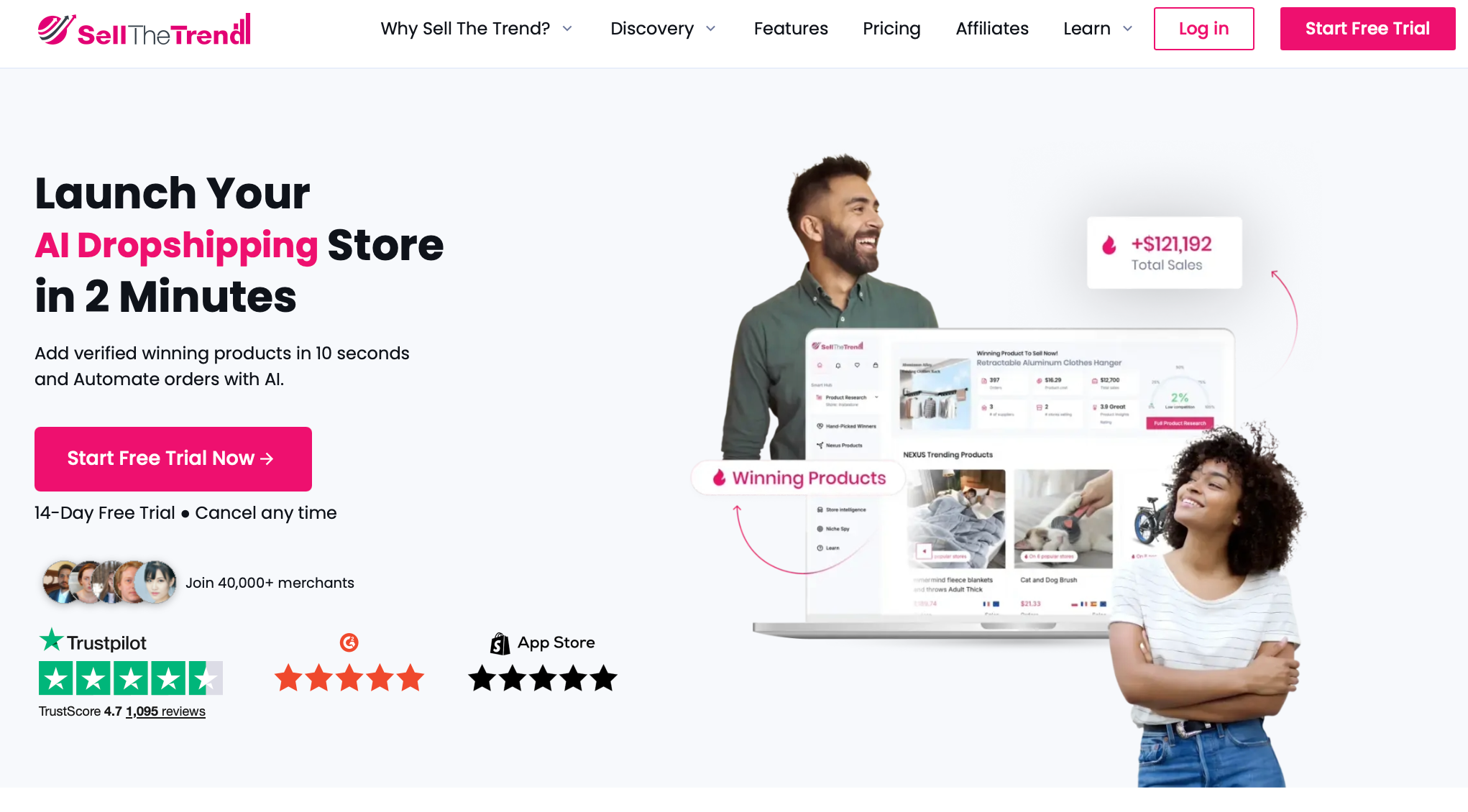
Sell The Trend is built for sellers who want to do more than browse products. It helps you find winning products, review supplier options, import products to your store, and handle more of the testing and launch process without relying on as many separate apps.
It is positioned as an all-in-one, AI-powered platform for finding products, launching offers, and supporting fulfillment workflows from one place That broader setup makes it easier to replace scattered tools with one system that covers more of the workflow
This makes it a strong fit for beginners who want a faster start and for experienced sellers who want to reduce manual work across research, store setup, and marketing support with a more user friendly interface.
It also includes curated product recommendations and tailored product suggestions, which can save time when sellers want ready-to-review options instead of starting every search from scratch. For users focused on testing products quickly, that creates a smoother path from research to action.
Sell The Trend also supports the marketing side of the process with built-in creative, ad tools and app sell support tools. Combined with its store workflows and automation features, that gives sellers a broader setup than a tool that only handles sourcing or product browsing.
The platform also highlights customer success stories and a published case study, which reinforces its positioning as a broader system rather than just a research tool
Overall, Sell The Trend is designed for sellers who want a faster, more connected workflow, with all the tools needed to move from research to launch in one place. It is especially useful for people who prefer an all in one solution instead of piecing together separate apps for research, importing, and store management.
What features are included in Sell The Trend in 2026?
Sell The Trend includes the tools sellers usually end up patching together elsewhere: product research, supplier access, store setup, automation, ad support, and competitor research. That matters because it cuts down the time and cost of testing trending products with a scattered stack
Functionality |
Included in Sell The Trend |
What You’d Need Separately without Sell The Trend |
|---|---|---|
AI product research |
Uses AI-based research and an ai powered product workflow to help sellers spot opportunities earlier and review products with more context |
With simpler tools, you may only get basic product lists or limited sourcing data. |
Supplier sourcing |
Includes built-in supplier access so sellers can review products and move them into their workflow more easily. |
Separate supplier directories or sourcing platforms are often needed. |
Store builder |
Includes SellShop plus integrations with Shopify, TikTok Shop, eBay, and other sales channels. |
A separate store builder or ecommerce platform would usually be required. |
Automation |
Supports importing, syncing, and order workflows inside the platform, making it a better fit for sellers building around ai dropshipping workflows. |
Separate automation software is usually needed when these features are not built in. |
Ad tools |
Includes tools for ad creation, testing support, and marketing workflows inside the same system, including a Video Ad Creator and Facebook Audience Builder for faster campaign setup. This can be a game changer for sellers who do not want separate creative and ad research tools |
Separate ad spy or creative tools are often needed. |
Competitor insights |
Includes store and competitor research tools that help sellers review product movement, trends, and opportunities in one place. |
Separate research apps or browser extensions are usually needed for competitor analysis. |
What Is Syncee?
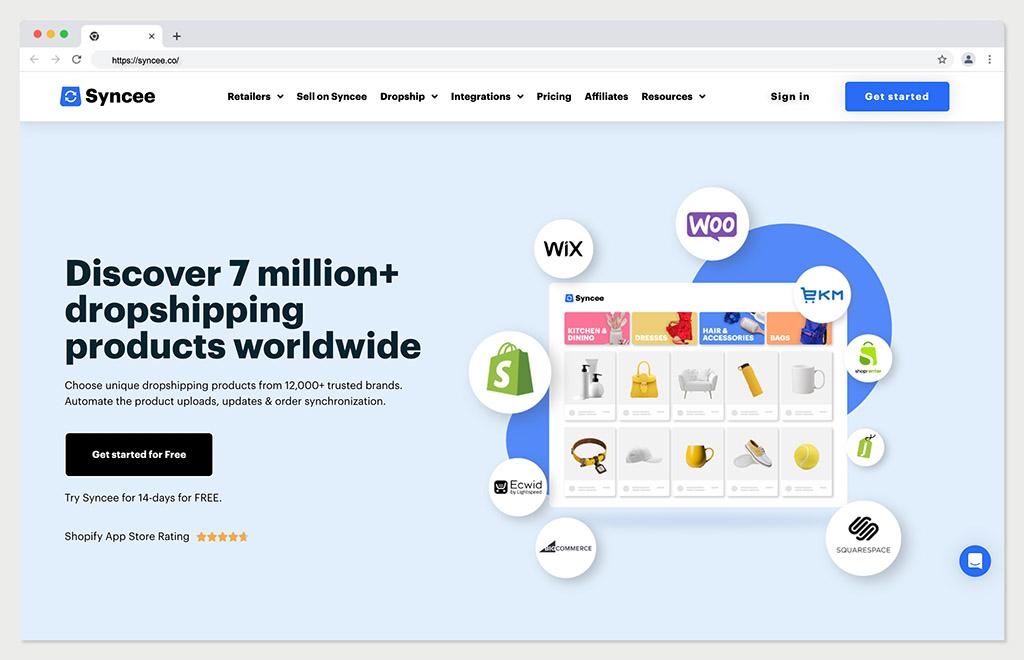
Syncee is a dropshipping and wholesale platform that helps sellers find suppliers, import products, and manage their store catalog more efficiently. Instead of focusing mainly on competitor tracking or deep product validation, it is built around supplier sourcing, product imports, inventory syncing, pricing updates, and supplier connections.
The platform gives users access to a large supplier marketplace, and tools that help keep product data updated across ecommerce platforms. It gives users access to a broad supplier network including millions of ready-to-sell products from a global network of suppliers
Instead of manually searching for suppliers, uploading products, and updating inventory or pricing changes by hand, users can browse supplier listings, review supplier details, add products to their store, and keep their catalog synced more easily. This makes it especially useful for store owners who want a more streamlined way to manage sourcing and supplier-side operations.
Syncee is best understood as a global B2B marketplace focused on verified suppliers, local shipping, and broader supplier relationships rather than deep market research. Syncee focuses mainly on supplier access, product importing, and catalog syncing. Its value is more about sourcing high quality products and managing catalog operations than deep market validation.
It is not mainly built for competitor analysis, advanced product validation, or research-heavy product discovery. Sellers who want stronger research features usually need another tool for trend analysis and validation. In other words, Syncee is stronger for sourcing and supplier management, but weaker as a dedicated product research platform
What features are included in Syncee in 2026?
Functionality |
Included in Syncee |
What You’d Need Separately without Syncee |
|---|---|---|
Supplier marketplace |
Access to trustworthy suppliers across the US, EU, UK, AU, and other regions, including EU suppliers. Syncee also highlights pre-vetted suppliers, local items, and curated products from 12,000+ brands, with more emphasis on high quality than high volume |
Separate supplier directories or wholesale marketplaces would usually be required. |
Product sourcing |
Includes marketplace search and AI-supported sourcing to help sellers find products and narrow options by supplier and catalog fit. This makes it a valuable tool for finding an inventory source for a dropshipping business, even if it is not a deep research platform. It is useful for sellers who want more accurate information when reviewing sourcing options |
Manual sourcing or a separate sourcing app is often needed. |
Product sync |
Supports synced imports, bulk uploads, and an automated product sync workflow for inventory and pricing updates across connected stores. This is one of Syncee’s core dropshipping automation features and helps with ongoing inventory management. |
Manual imports, spreadsheets, or separate sync software are often needed. |
Order workflow |
Supports supplier-side order flow after a sale, including a smoother handoff between retailer and supplier. Syncee positions this as part of its broader dropshipping automation workflow for store operations. |
Separate routing, fulfillment, or order management apps may be needed. |
Supplier communication |
Includes built-in messaging so sellers can contact suppliers directly inside the platform. This is useful when checking shipping terms, product quality, or supplier policies before adding items to a store. |
Email or external communication tools may be needed. |
Custom pricing rules |
Lets sellers easily create tiered pricing rules and manage pricing settings by vendors and settings by vendors brandsfor better margin control. It also allows users to set unique pricing rules for import lists, including tiered pricing by vendors, brands, or categories |
Separate pricing automation tools would often be required. |
Sell The Trend vs Syncee: How does their pricing compare in 2026?
Platform |
Entry Plan |
Mid Plan |
High Plan |
Free Plan / Trial |
|---|---|---|---|---|
Sell The Trend |
$29.97/month |
$49.97/month |
$99.97/month |
14-day free trial available |
Syncee |
Free plan available |
$39.99/month (Basic) |
$59.99/month (Pro) / $99.99/month (Business) |
3-day free trial on monthly plans |
Syncee can look cheaper at first because it offers a free plan and a lower supplier-first entry point. But Sell The Trend includes more of the tools sellers use and offers a more complete workflow with fewer gaps, while Syncee is more focused on sourcing and sync. If you are trying to avoid paying for separate research and ad tools, Sell The Trend usually gives more usable value per month.
Total Cost of Ownership: What Syncee Really Costs When You Add Everything
This is where the gap becomes clearer. Syncee can work well if supplier access is your main need, but many sellers will still need separate tools to research products, study competitors, and test ad angles.
Sell The Trend is stronger for sellers who want fewer moving parts because more of the testing and launch workflow is already built in. That makes the real comparison less about entry price and more about how many extra subscriptions you need to get results.
Sell The Trend also promotes itself as an all-in-one product research and marketing engine, while Syncee positions itself more as a premium dropshipping and wholesale marketplace for stores across multiple platforms.
Here’s a side-by-side breakdown of what Sell The Trend includes out of the box and what you would still need to add when using Syncee.
Requirement |
Sell The Trend ($49.97) |
Syncee ($39.99/mo) |
|---|---|---|
Product Research |
Included |
+$29.97/mo (separate research tool) |
Store Builder |
Included |
+$39/mo (Shopify Basic) |
Order Automation |
Included |
Included |
Supplier Sourcing |
Built-in supplier tools |
Included |
Ad Research |
Included |
+$49/month Minea of similar needed |
Total Est. Cost |
$49.97/month |
$157.96+/month |
This is why Syncee can work well for supplier-first sellers, but Sell The Trend makes more sense for users who want a broader system with fewer extra tools.
It is also why subscription costs and long term success matter more than just the lowest monthly price. That is why free plans, trial periods, integration quality, and scalability matter just as much as the headline monthly price when comparing dropshipping software
What Are the Best Alternatives to Sell The Trend and Syncee in 2026?
The best alternative depends on what you are missing. Some sellers want better sourcing and fulfillment, some want stronger ad research, and some just want simple Shopify store analysis.
But that is also where Sell The Trend keeps an advantage for buyers who do not want to stack multiple tools—many alternatives solve one narrow problem well, while Sell The Trend is built to cover more of the product research, launch, and marketing workflow in one place.
The right choice depends on whether you care more about ad research, sourcing, fulfillment, or building a more complete stack of comprehensive dropshipping tools.
It also helps to compare analytics, reporting, automation depth, and real user feedback before committing to a platform. Below are some of the most relevant alternatives and what each one does best.
1. CJ Dropshipping — Sourcing and Fulfillment
CJ Dropshipping is best for sellers who need supplier support and fulfillment rather than deep product research. It is useful for finding dropshipping products, working with sourcing agents, and handling warehousing with faster delivery options. CJ highlights sourcing agent services, fulfillment centers, and global warehouses built for ecommerce sellers.
Key features include:
Supplier sourcing and fulfillment support
Warehousing and shipping options
Product requests and custom sourcing
Better fit for operations than research
CJ is useful if your biggest need is sourcing and fulfillment, but it is not the strongest option for product validation or ad research.
2. Koala Inspector — Simple Shopify Store Analysis
Koala Inspector is a chrome extension built for Shopify research. Its official positioning is simple: it helps users inspect stores, apps, themes, and products, which is why it is often chosen by sellers who want a lightweight research tool rather than a larger platform. Koala says it reveals best-selling products, installed apps, themes, and estimated sales from Shopify stores.
Key features include:
Store and theme detection
Product visibility and app detection
Best for quick competitor reviews
Easy starting point for Shopify research
Koala Inspector works best for users who want fast store checks instead of deeper workflow tools.
3. Shopify Collective — Native Supplier Partnerships
Shopify Collective is a strong option for merchants who want supplier partnerships inside Shopify itself. It is better suited to stores that already run on Shopify and want access to curated retail partnerships rather than a large open supplier marketplace like Syncee.
This can appeal to sellers interested in more curated supplier partnerships and collective dropshipping models inside Shopify. This can be a practical choice for stores that care about branded products and lower-risk sourcing through existing merchants.
Key features include:
Native Shopify supplier relationships
Easier product syncing inside Shopify
Better fit for existing Shopify merchants
Useful for supplier-first store expansion
This makes it more specialized than a broader marketplace with reliable suppliers across many regions.
4. WinningHunter — Paid Traffic and Ad Research
WinningHunter is an ad intelligence tool focused on tracking what is working in paid traffic. Its content and research materials emphasize ad discovery, winning creatives, active campaign tracking, and store validation. That makes it a better fit for sellers who want faster ad-led validation than for those who mainly need supplier syncing.
Key features include:
Ad research across major channels
Focus on active paid campaigns
Strong for ad-led validation
Helpful for faster campaign testing
It is a better fit for sellers who care most about ads rather than sourcing or fulfillment.
5. Minea — Creative-Focused Ad Intelligence
Minea is best known for ad research and creative tracking. Its official pages position it as an all-in-one ecommerce product search and AdSpy tool, but its strongest angle is still campaign analysis and creative discovery. Minea is more useful for sellers who want to study ad performance than for those looking for supplier marketplaces or inventory sourcetools.
Key features include:
Creative-focused ad research
Multi-platform ad tracking
Useful filters for campaign review
Better for ads than store syncing
This makes Minea better for ad-led testing than for supplier management.
Overall, these alternatives are useful because they each solve a narrower problem well. Some are better for sourcing, some for ads, and some for Shopify-native partnerships. If you want one platform to cover research, launch, and marketing, Sell The Trend still makes more sense. If you mainly want vetted suppliers, local sourcing, and syncing for long-term store growth, Syncee remains the better fit.
Feature Breakdown: How do Sell The Trend and Syncee compare?
1. What are the product research capabilities of each tool?
Sell The Trend is stronger for sellers who want to find winning products and move faster from research to testing because it is built around validation, market signals, launch support, and a smoother experience for new users.
Syncee also includes product discovery features, such as marketplace search, filters, and AI-assisted product finding, but its core strength is supplier-backed sourcing rather than deep product validation or competitor research. If research speed and product testing are the priority, Sell The Trend is the stronger pick. If supplier browsing and ready-to-import listings are the priority, Syncee fits better.
Key differences include:
Sell The Trend is better for broad research and faster testing
Syncee is more focused on supplier-side sourcing than deep validation
Sell The Trend is stronger for finding opportunities before launch
Verdict: Verdict: Sell The Trend is stronger for sellers who want to find and validate products before spending money on testing, especially since it supports that workflow with broader tools and responsive customer support.
2. How do their databases and filters compare?
Sell The Trend is stronger for sellers who want to scan opportunities quickly and narrow products based on validation signals, not just supplier availability. Syncee is stronger for sellers who care more about supplier catalogs, vendor details, and sourcing control inside an existing store workflow, with access to millions of products across its marketplace. That makes Sell The Trend better for fast testing, while Syncee is better for supplier-led merchandising.
Key differences include:
Sell The Trend is broader for market scanning
Syncee is stronger for supplier catalog management
Sell The Trend is better for fast validation
Verdict: Sell The Trend is better for sellers who want to narrow products based on market potential and testing opportunities, while Syncee is better for sellers who care more about supplier catalogs and sourcing depth.
3. Which platform supports store creation and automation?
Sell The Trend is stronger for sellers who want to go from product idea to store launch with fewer extra tools because it includes a built-in store builder and covers more of the research, setup, and execution workflow. Syncee does not include a store builder.
Instead, it is built for sellers who already have a storefront on platforms like Shopify, Wix, WooCommerce, or other supported ecommerce systems and mainly want synced listings, inventory updates, a smoother order process, and more seamless integration with supplier-side workflows. Choose Sell The Trend for launch speed and built-in store creation; choose Syncee for supplier-side operations, comprehensive automation and catalog syncing.
Key differences include:
Sell The Trend includes built-in store creation
Syncee does not include a store builder and requires an existing storefront
Sell The Trend covers more of the overall launch workflow
Syncee is stronger for supplier-side syncing and catalog operations
Verdict: Sell The Trend is stronger for sellers who want to go from product idea to store launch with fewer moving parts because it includes store creation as part of the platform, while Syncee focuses more on flawless integration into stores that already exist.
4. How do they compare on analytics?
Sell The Trend is stronger for pre-launch decision-making because it is positioned around product validation, competitor research, and identifying opportunities before you spend on testing. Syncee is more operational, with stronger emphasis on syncing, suppliers, and catalog workflows than on broader market intelligence. Sellers who want more confidence before launching products will usually get more value from Sell The Trend here.
Key differences include:
Sell The Trend is stronger for research visibility
Syncee is more operational than analytical
Sell The Trend gives sellers more insight before launch
Verdict: Sell The Trend is stronger for sellers who want better product validation and pre-launch decision support. Syncee is more useful for sellers focused on supplier-side operations than broader market or competitor analysis.
5. Which tool is better for competitor research and marketing support?
Sell The Trend is stronger for sellers who want to research competitors, study ad angles, and build creatives without relying on separate tools because it includes ad research and competitor-focused features as part of its broader workflow. Syncee is not built for ad spy research or creative analysis. Its strength is supplier sourcing, product discovery inside its marketplace, and catalog management rather than campaign research. If your growth plan depends on faster validation and built-in marketing research, Sell The Trend has the clearer edge.
Key differences include:
Sell The Trend includes stronger marketing and competitor research support
Syncee does not include ad spy tools and is not designed for ad research
Sell The Trend is better for launch-focused sellers who want research and execution in one place
Verdict: Sell The Trend is the better fit for sellers who want built-in competitor research, ad angles, and creative support without relying on separate tools. Syncee is better suited to sellers whose priority is supplier sourcing, product imports, and catalog syncing rather than marketing research.
6. Do they support suppliers and sourcing?
Both platforms support sourcing, but in different ways. Sell The Trend includes sourcing inside a broader research-and-launch system, which makes it more balanced overall.
Syncee is more specialized on supplier access, and syncee takes a more supplier-first approach than Sell The Trend. Syncee is a specialized marketplace focused on connecting retailers with vetted, high-quality, local suppliers in the US, EU, and AU for faster shipping.
It is also positioned as a collective dropshipping and wholesale marketplace where retailers and suppliers connect across regions including the US, CA, EU, UK, and AU.
Syncee allows users to invite their own suppliers to the platform for better management, which adds more supplier-side flexibility and a few unique features for stores with existing vendor relationships.
In addition, Syncee allows retailers to start with dropshipping and easily transition to bulk wholesale once a product is validated.
Other strengths include platform coverage and payment structure. Syncee supports all major e-commerce platforms, making it versatile for various online stores. Also, Syncee does not charge unexpected transaction fees after orders, unlike some other platforms.
Key differences include:
Sell The Trend supports sourcing within a broader system
Syncee is stronger for supplier-first operations
Sell The Trend is better if sourcing is only one part of the workflow
Verdict: Syncee is stronger for sellers whose main priority is supplier sourcing, synced imports, and catalog management. Sell The Trend is stronger for sellers who want sourcing included inside a bigger product research and launch workflow.
Conclusion
Sell The Trend is the stronger choice for sellers who want to find products, validate them, and launch with fewer extra tools because it covers more of the full workflow in one place. As an all-in-one product research and marketing engine, it is especially well suited to beginners who want a more plug-and-play system for faster testing and smoother execution.
Syncee is the better choice for sellers who already have a store and mainly need supplier access, synced product imports, and catalog management. For most beginners and testing-focused sellers, Sell The Trend is the better fit.
For supplier-first operators, Syncee can still be the smarter pick. Start with Sell The Trend and build your store with a platform designed to help you test smarter, launch faster, and scale with more confidence.

Inspected by Rachid “Rush” Wehbi
Founder of Sell The Trend, Rush is a data-driven entrepreneur with over 10 years of experience in e-commerce, automation, and product discovery. Each article is reviewed to ensure it reflects real-world workflows, industry insights, and platform-level accuracy.
Frequently asked questions
Is Sell The Trend or Syncee better for beginners?
Sell The Trend is usually better for beginners because it provides research, validation, and launch workflows in one place.
Syncee is better suited for sellers who already know how to manage supplier-side operations.
What is the main difference between Sell The Trend and Syncee?
The main difference is that Sell The Trend is a broader product research and launch platform.
Syncee is more focused on supplier sourcing, catalog syncing, and seller workflows, supported by onboarding help and training resources.
Does Syncee include product research tools?
Syncee includes product discovery features, but it is not a strong product research platform.
Its discovery tools are more focused on sourcing and catalog browsing rather than deep validation.
Does Syncee include a store builder?
No.
Syncee does not include a built-in store builder, making it less complete for sellers who want an all-in-one workflow.
Sell The Trend is stronger because it supports more of the process from product idea to store launch.
Which platform is better for supplier sourcing?
Syncee is strong for supplier sourcing.
It supports messaging and supplier communication, including live chat within the platform.
However, it focuses more on communication and sourcing rather than deeper product research.
Which platform is better overall?
Sell The Trend is the better overall platform for most sellers because it covers more than just one function.
Syncee is useful for supplier imports and syncing but is weaker as a complete system for product discovery, validation, and launching.
Sell The Trend is also praised for its user-friendly interface and responsive customer support, making it easier to adopt than a fragmented tool stack.
Should a free plan or trial matter when choosing between Sell The Trend and Syncee?
Yes.
A free plan or trial allows sellers to test features, usability, and workflow before committing to a paid plan.
What should sellers consider beyond features and pricing?
Sellers should consider long-term fit.
Scalability is important because the software should grow with your business and support more complex needs over time.