Sell The Trend vs Shophunter
Comparing an all‑in‑one dropshipping platform with a fulfillment automation tool.
Get started for free
Updated on: March 2026
If you're comparing Sell The Trend vs ShopHunter in 2026, the main question is what kind of seller you are. Sell The Trend is stronger for sellers who want one platform to find winning products, connect suppliers, import products, and automate more of the store workflow . ShopHunter is better for sellers who already have their store stack in place and mainly want to track Shopify stores, monitor products, and validate what competitors are already selling.
Key Takeaways
-
Sell The Trend is better for sellers who want a broader workflow. Its all-in-one platform goes beyond research by also supporting store building, marketing tools, and a more complete store setup.
-
ShopHunter is better for sellers who mainly want to track Shopify stores, monitor product activity, and study competitor performance. However, it is more limited in scope because it focuses on store intelligence and product validation rather than helping sellers run the rest of their workflow.
-
Sell The Trend also gives users more room to expand with tools for niche discovery , store intelligence , and broader product testing support.
-
If you want one platform that covers more of the dropshipping process, Sell The Trend offers more overall.
-
If you mainly want to spy on Shopify stores and analyze competitor sales signals, ShopHunter is the more focused option, but it does not cover as much of the operational side of building and running a store
Sell The Trend vs ShopHunter in 2026: Which One Is Better?
Sell The Trend is better for sellers who want to go from product discovery to launch with fewer extra tools because it combines research, supplier access, importing, and automation in one system. ShopHunter is better for sellers who mainly want to study Shopify competitors, track store activity, and validate products that already show traction.
The better choice depends on whether you need a full dropshipping workflow or just competitor intelligence.
What is the main difference between Sell The Trend and ShopHunter in 2026?
The biggest difference is that Sell The Trend helps sellers move from finding products to listing them, connecting suppliers, and managing more of the backend workflow in one place, while ShopHunter is mainly built for tracking Shopify stores, products, and revenue signals.
That makes Sell The Trend stronger for launch and scaling, while ShopHunter is stronger for sellers who only need competitor research.
This side-by-side matters because both tools help with research, but only one is positioned to cover more of the day-to-day dropshipping workflow. Sell The Trend is built for sellers who want product discovery, sourcing support, store workflows, and ad research in one platform, while ShopHunter stays more focused on Shopify store intelligence.
Feature |
Sell The Trend |
ShopHunter |
|---|---|---|
|
AI-backed research with trend signals, product discovery, and broader workflow tools. |
Focused on tracking Shopify products, store activity, and estimated revenue. |
|
|
Store Builder |
Includes a built-in store builder plus integrations with multiple selling channels. |
Not a store builder. Designed mainly for spying on Shopify stores. |
Operations |
Supports 1-click product listing , supplier connections, and workflow support beyond research. |
Does not position itself as a tool for product importing, supplier management, or running store operations. |
Competitor Research |
Includes Competition Explorer and broader competitor analysis inside a larger platform. |
Stronger as a pure Shopify spying tool for store-level tracking, best sellers, pricing changes, and revenue estimates. |
Ad Research |
Includes built-in TikTok ad and Facebook ad tools as part of the wider system. |
Highlights Facebook competitor ad spying, but remains narrower overall. |
Supplier Access |
Includes supplier-focused workflow support and verified US/EU supplier options. |
No built-in supplier network is highlighted as a core part of the platform. |
Pricing (Starting Plan) |
Pricing page shows plans starting at $29.97/month, with free trial messaging on the site. |
Public listings show pricing from about $50/month, and the official site promotes a 3-day $1 trial. |
If you want fewer moving parts and less tool stacking, Sell The Trend offers a more complete setup. It also goes beyond Shopify alone, with integrations listed for Shopify, TikTok Shop, eBay, Amazon, WooCommerce, and Wix, while ShopHunter stays much more focused on Shopify store tracking and revenue visibility.
What Is Sell The Trend?
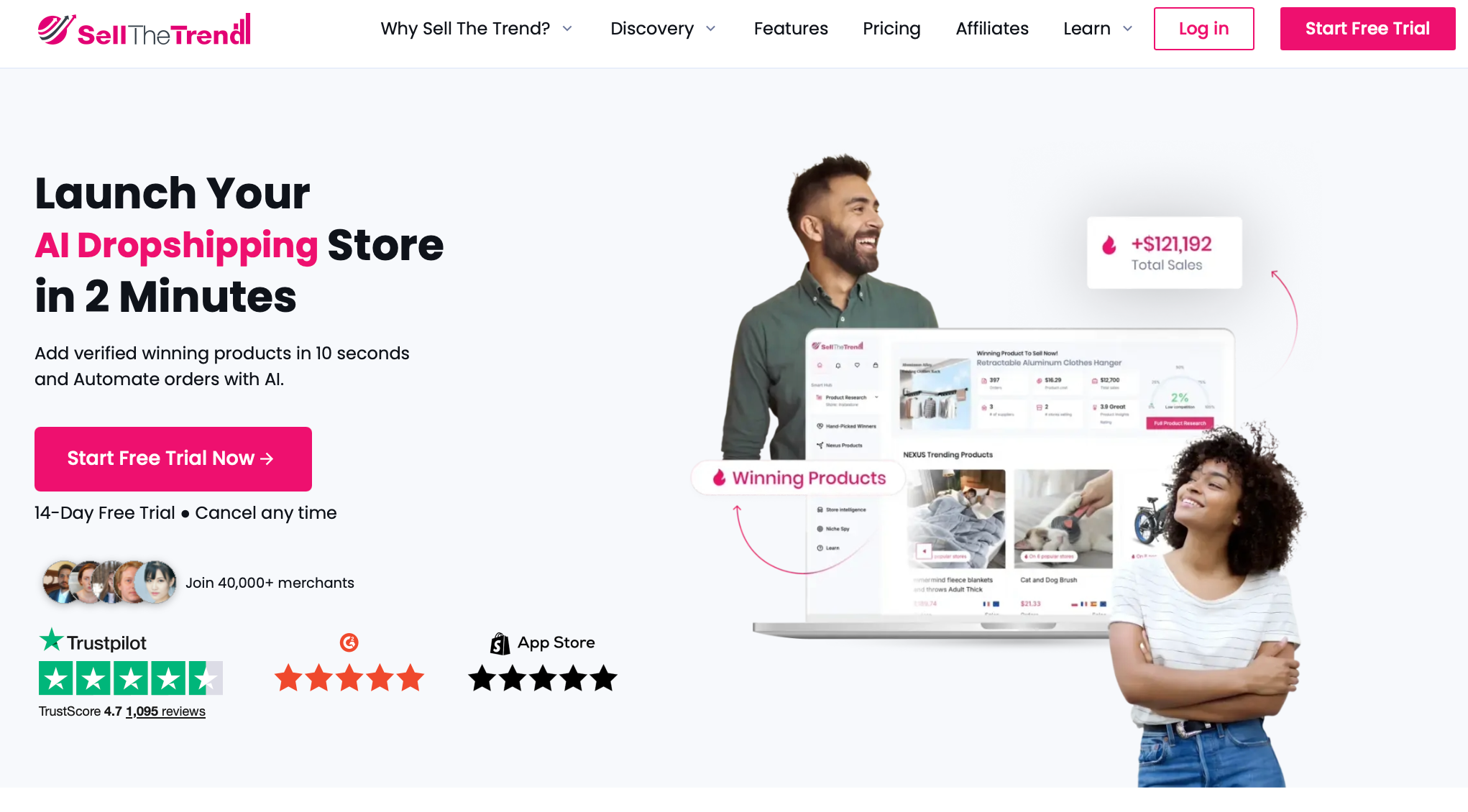
Sell The Trend is built for sellers who want to find winning products, import them faster, connect suppliers, and manage more of their store workflow without stacking as many separate tools.
Instead of stopping at product ideas, it connects research, sourcing, store integrations, and execution tools in one platform, which makes it more useful for both beginners trying to launch faster and experienced sellers trying to scale with less manual work.
It also includes curated hand-picked product selections, which can help sellers move faster when they want ready-to-review ideas instead of starting every search from scratch.
In addition, sellers can create ad assets inside the platform and use built-in tools to support testing and branding. Sell The Trend is designed for both beginners and more experienced sellers.
Beginners can use it to launch faster, while experienced sellers can use it to simplify research, reduce manual work, and scale more efficiently. The platform also highlights customer success stories and a published case study, which reinforces its positioning as a broader system rather than just a research tool.
What features are included in Sell The Trend in 2026?
Functionality |
Included in Sell The Trend |
What You’d Need Separately without Sell The Trend |
|---|---|---|
AI product research |
Uses AI-based product analysis, trend signals, and discovery tools to help sellers spot promising products earlier. |
With simpler research tools, you may only get curated product lists without the same level of built-in analysis. |
Supplier sourcing |
Built-in supplier connections help sellers find products and move them into their store workflow more easily. |
Separate supplier platforms are often needed when supplier access is not built in. |
Store builder |
Includes SellShop plus integrations with Shopify, TikTok Shop, eBay, and other channels for launching and managing stores. |
A separate store platform or website builder would usually be required. |
Supports product importing, fulfillment support, inventory syncing, and tracking workflows inside the platform. |
Separate automation software is usually needed when these functions are not included. |
|
Ad tools |
Includes tools for ad creation and product testing support inside the same system. |
Separate ad spy or creative tools are often needed. |
Competitor insights |
Includes store and market analysis tools to help sellers review competitors, product movement, and activity in one place. |
Separate research tools or browser-based extensions are usually needed for competitor analysis. |
What Is ShopHunter?
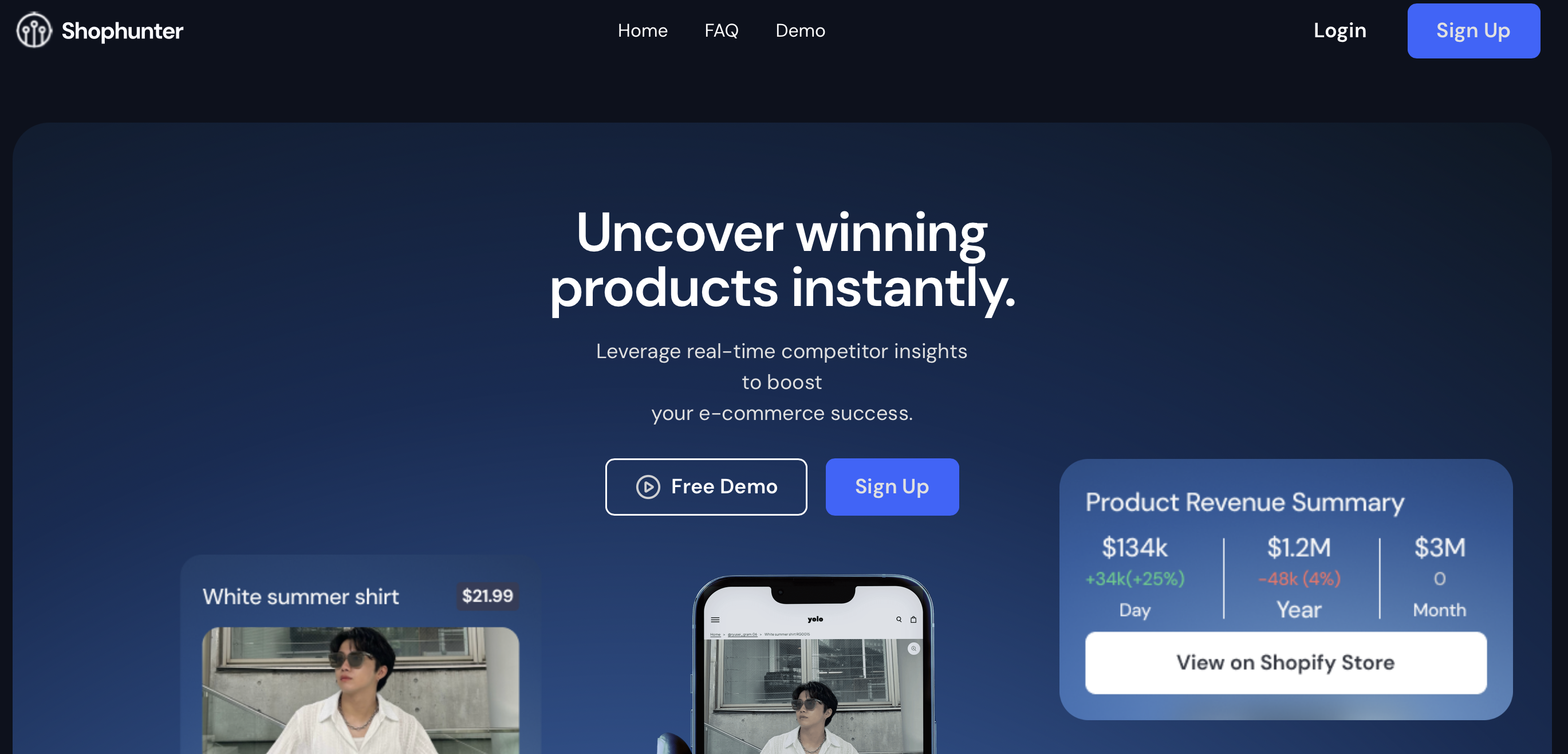
ShopHunter is a dropshipping product research tool that helps sellers analyze Shopify stores that are already performing well. Instead of focusing on store setup or automation, it is built around store tracking, sales estimates, and product validation. The platform gives users access to store data, revenue estimates, and detailed insights into what competing stores are selling.
The platform is designed to help sellers save time during the product research process. Instead of doing everything manually, users can review sales trends, market trends, and product activity across competitor stores to spot trending products and evaluate potential opportunities. This makes it especially useful for shopify store owners who want to study direct competitors and make more data driven decisions.
ShopHunter focuses mainly on competitor analysis and store research. It does not include store automation, supplier tools, or broader store operations features. Sellers usually need other tools for product importing, fulfillment, and sourcing. In other words, ShopHunter is stronger for research, but weaker as a full operating system for a growing dropshipping business.
What features are included in ShopHunter in 2026?
Functionality |
Included in ShopHunter |
Similar tools are needed separately |
|---|---|---|
Product research |
Helps sellers analyze Shopify stores, review winning products, study sales trends, and spot products that already show traction. It also gives users detailed insights into store activity and product movement. |
Broader tools are needed if you want built-in product importing, sourcing, and workflow support. |
Competitor insights |
Strong for researching competitor stores, reviewing pricing strategies, monitoring store performance, and checking revenue estimates across tracked stores. |
More complete platforms are needed if you want competitor research connected to sourcing, automation, and launch tools. |
Analytics |
Includes store data, revenue tracking, and sales estimates to help sellers understand what products and stores are performing best. |
Broader platforms are better if you want analytics tied directly to operations and execution. |
Automation |
Not included. ShopHunter does not provide store automation or backend workflow tools for running a store. |
Tools like AutoDS or DSers are required for automation. |
Store builder |
Not included. ShopHunter is not built for store creation or managing multiple platforms. |
Shopify or other store builders are needed separately. |
Supplier integration |
Not included. ShopHunter does not include supplier sourcing or fulfillment support. |
Supplier platforms like CJ Dropshipping, AliExpress, or Spocket must be used separately. |
Ad research |
Limited compared with dedicated ad tools. It is not primarily built for ad research, ad creatives, or campaign testing workflows. |
Tools like Minea or WinningHunter are needed for deeper ad research. |
Sell The Trend vs ShopHunter: How does their pricing compare in 2026?
Platform |
Entry Plan |
Mid Plan |
High Plan |
Free Plan / Trial |
|---|---|---|---|---|
Sell The Trend |
$29.97/month |
$49.97/month |
$99.97/month |
14-day free trial available |
ShopHunter |
$50/month |
$75/month |
$250/month |
Free trial available |
At first glance, ShopHunter may seem simpler because it is focused mainly on store research. But Sell The Trend includes more of the workflow in one platform, which gives it more value for sellers who want more than just competitor tracking.
If you only need store research and competitor insights, ShopHunter may be enough. If you want a more complete system without stacking extra tools, Sell The Trend covers more of the process.
Total Cost of Ownership: What ShopHunter Really Costs When You Add Everything
This is where the gap becomes clearer. ShopHunter may cover research, but sellers still need to pay for store software, automation, and supplier workflows if they want a complete setup. Sell The Trend covers more of that process inside one platform, which makes it the stronger value play for sellers who want fewer moving parts and a lower total tool stack.
Here’s a side-by-side breakdown of what Sell The Trend includes out of the box and what you would still need to add when using ShopHunter.
Requirement |
Sell The Trend ($49.97) |
ShopHunter ($50/mo) |
|---|---|---|
Product Research |
Included |
Included |
Store Builder |
Included |
+$39/mo (Shopify) |
Order Automation |
Included |
+$26.90/mo (AutoDS or similar) |
Supplier Sourcing |
Built-in supplier tools |
Manual research / separate tool needed |
Ad Research |
Included |
Separate tool often needed |
Total Est. Cost |
$49.97/month |
$115.90+/month |
This is why ShopHunter can work well as a research tool, but Sell The Trend makes more sense for sellers who want a broader system with fewer extra tools.
What Are the Best Alternatives to Sell The Trend and ShopHunter in 2026?
The best alternative depends on the gap you are trying to fill. These tools can be useful on their own, but most are narrower than a full platform. Some focus on basic features, while others offer more advanced features for sellers who want deeper research. The right choice depends on whether you need ad research, supplier workflows, or deeper store analysis.
Below are some of the most relevant alternatives and what each one does best.
1. CJ Dropshipping — Sourcing and Fulfillment
CJ Dropshipping is best for sellers who need supplier support and order fulfillment rather than deep product research. It is useful for finding products, working with agents, and matching suppliers for faster shipping and smoother backend workflows.
Key features include:
Supplier sourcing and fulfillment support
Warehousing and shipping options
Product requests and custom sourcing
Better fit for operations than research
CJ is useful if your biggest need is sourcing and fulfillment, but it is not the strongest option for product validation or competitor research.
2. Koala Inspector — Simple Shopify Store Analysis
Koala Inspector is a chrome extension built for Shopify research. Its official positioning is simple: it helps users inspect stores, apps, themes, and products, which is why it is often chosen by sellers who want a lightweight research tool rather than a larger platform.
Key features include:
Store and theme detection
Product visibility and app detection
Best for quick competitor reviews
Easy starting point for Shopify research
Koala Inspector is a Shopify-only spy tool designed for simplicity, so it works best for users who want fast store checks instead of deeper workflow tools.
3. Adnosaur — Fashion Ad Research
Adnosaur is a fashion-focused product research tool built around Facebook ad data. Its site says it concentrates on fashion products and uses Facebook ad signals as its main source of research, which makes it more niche than broader tools.
Key features include:
Fashion-specific research
Ad tracking from the facebook ad library ecosystem
Product and competitor insight for apparel sellers
Better suited to niche-focused testing
This makes Adnosaur more relevant for fashion sellers than for general ecommerce users.
4. WinningHunter — Paid Traffic and Ad Research
WinningHunter is an ad intelligence tool focused on tracking what is working in paid traffic. Its official site emphasizes Facebook and TikTok ad discovery, store tracking, and performance filters for active campaigns.
Key features include:
Ad research across major channels
Focus on active paid campaigns
Strong for ad-led validation
Helpful for refining marketing strategies
It is a better fit for sellers who care most about ads rather than supplier workflows or store building.
5. Minea — Creative-Focused Ad Intelligence
Minea is best known for ad research and creative tracking. While it has broadened its platform, its strongest angle is still ad discovery and campaign analysis, especially for sellers who want to study ad creatives and creative performance.
Key features include:
Creative-focused ad research
Multi-platform ad tracking
Useful filters for campaign review
Better for ads than store spying
Minea is an ad intelligence platform focused on creative analysis rather than store tracking.
6. Dropship.io — Sales and Store Validation
Dropship.io is one of the stronger tools for sellers who want store and product validation. Its official site highlights a product library, sales tracker, competitor research, and ad tools, with a focus on store revenue and product visibility.
Key features include:
Access to store and product tracking
Better visibility into real time sales data
Useful for product and store validation
Helpful for sellers comparing sales performance across stores
Dropship.io blends estimated sales data, Shopify store and product pricing insights, and Facebook ad performance to help validate demand.
7. ZIK Analytics — Marketplace Validation
ZIK Analytics is more focused on marketplace research than pure dropshipping spy features. Its site positions it around eBay first, with Shopify and AliExpress support also mentioned.
Key features include:
Research based on marketplace data
Product validation across multiple channels
Useful for broader product demand checks
Better fit for sellers working across other e commerce platforms
This makes it useful for sellers who want validation beyond a Shopify-only workflow.
8. Niche Scraper — Product and Store Research
Niche Scraper is built around product research and Shopify store analysis. Its official site describes it as a tool for spying on Shopify stores and finding products that are already proven to sell.
Key features include:
Product scraping and store research
Filters for product discovery
Built-in examples and product validation
Useful for finding profitable niches
Niche Scraper is a product research and competitor analysis tool focused on scraping winning products and Shopify stores.
Overall, these alternatives are useful because they each solve a narrower problem well. Some are better for sourcing, some for ads, and some for product validation. For e commerce entrepreneurs who want a single system, an all-in-one platform will usually feel simpler. For sellers who prefer specialized tools, these alternatives can work well when chosen for the right job.
Feature Breakdown: How do Sell The Trend and ShopHunter compare?
1. What are the product research capabilities of each tool?
Sell The Trend is stronger for sellers who want to discover and validate products from multiple angles because it combines AI-backed research, supplier data, ad signals, and store insights in one workflow.
ShopHunter is stronger for sellers
who mainly want to check which products are already moving inside Shopify stores. If your goal is broad discovery,
Sell The Trend has the edge. If your goal is competitor validation, ShopHunter is more focused.
Key differences include:
Sell The Trend helps sellers discover winning products across a broader research workflow
ShopHunter is more focused on store spying and validation
Sell The Trend supports a wider research process beyond Shopify-only tracking
Identifying winning products through research can significantly increase the chances of success in dropshipping.
Verdict: Sell The Trend is better for broad product research. ShopHunter is
better for validating products that are already selling in Shopify stores.
2. How do their databases and filters compare?
Sell The Trend offers a larger product database with stronger filtering and deeper sorting options. Sellers can use advanced filters to narrow products by trend signals, supplier quality, and growth patterns.
ShopHunter is more focused on store level data from tracked Shopify stores. Its database is useful for direct competitor research, but it is narrower in scope.
Key differences include:
Sell The Trend offers broader filtering and research depth
ShopHunter focuses more on Shopify store tracking
Sell The Trend is better for broader discovery, while ShopHunter is more focused on validation
Verdict: Sell The Trend offers deeper research flexibility. ShopHunter is more specialized.
3. Which platform supports store creation and automation?
Sell The Trend supports more of the workflow after research. It includes store integrations, sourcing tools, and automation features that help sellers move from research to execution in one system.
ShopHunter does not include those operational tools. It is mainly a research platform, so sellers need outside tools for listing, sourcing, and backend workflows.
Key differences include:
Sell The Trend supports store workflows and order fulfillment
ShopHunter is mainly for research and store tracking
Sell The Trend works across Shopify and other e commerce platforms
ShopHunter features a simple interface for analyzing store data but lacks automation features, requiring external tools for listing products.
Verdict: Sell The Trend is stronger for execution.
ShopHunter is limited to research.
4. How do they compare on analytics?
Sell The Trend gives sellers broader research and performance visibility across products, stores, suppliers, and ads. It is built for sellers who want stronger reporting and deeper decision-making support.
ShopHunter is stronger when the goal is direct Shopify tracking. It focuses on real time sales data, revenue data, and store performance from tracked competitors.
Key differences include:
Sell The Trend is broader for research and decision-making
ShopHunter is stronger for direct store tracking
ShopHunter is useful for sellers who want tighter revenue visibility
Many dropshipping tools offer features that allow users to track sales performance and identify top-selling products in real-time.
Verdict: ShopHunter is stronger for direct Shopify tracking. Sell The
Trend is better for broader analytics.
5. Which tool is better for competitor research?
Sell The Trend includes competitor research inside a broader platform, which makes it useful for sellers who want competitor visibility along with sourcing and store workflows.
ShopHunter is more specialized in this area. It is built mainly for tracking Shopify competitors and reviewing store activity in detail.
Key differences include:
Sell The Trend includes competitor research inside a larger workflow
ShopHunter is more focused on store monitoring and direct competitor visibility
ShopHunter is useful for studying competitor strategies in Shopify stores
ShopHunter provides granular data on competitors' product listings, pricing strategies, and customer reviews.
Verdict: ShopHunter is stronger as a pure Shopify spying tool. Sell The Trend is
better if you want competitor research inside a larger platform.
6. What kind of marketing and ad research do they include?
Sell The Trend includes broader tools for ad research and product testing. It also includes a built-in video maker tool, which gives sellers more support for creative testing and marketing efforts.
ShopHunter is less focused on ad research. It is more useful for store validation than for campaign analysis or creative testing.
Key differences include:
Sell The Trend includes broader marketing support
ShopHunter is less focused on ad and creative research
Sell The Trend offers stronger support for testing products and campaigns
Verdict: Sell The Trend provides stronger marketing support. ShopHunter is more limited here.
7. Do they support suppliers and sourcing?
Sell The Trend includes stronger sourcing support and helps sellers move from product research into execution more easily. That makes it better for users who want research and supplier workflows inside one platform.
ShopHunter does not include sourcing tools. Sellers still need other platforms for supplier research and fulfillment.
Key differences include:
Sell The Trend supports supplier workflows
ShopHunter does not include sourcing tools
Sell The Trend is better for sellers who want a more complete system
Effective use of dropshipping tools involves leveraging data-driven insights to identify high-demand products and optimize inventory management.
Verdict: Sell The Trend is clearly stronger for sourcing
and execution. ShopHunter requires extra tools.
Overall, Sell The Trend is the more comprehensive solution. ShopHunter is useful for Shopify store research, but its limited features make it a narrower option once sellers need more than validation.
Conclusion
Choose Sell The Trend if you want a platform that helps you research products, study competitors, connect suppliers, and manage more of your workflow from one place. It is the stronger option for sellers who want more than just store spying and need a tool that can support growth over time.
Choose ShopHunter if you already have the rest of your setup in place and mainly want to track Shopify stores, monitor competitors, and validate products that are already selling.
Both tools can be useful, but Sell The Trend is the better fit for sellers who want a more complete system instead of stacking extra tools.
Start with Sell The Trend today if you want to find stronger product opportunities, simplify your workflow, and build your store with more confidence.
Ready to streamline your business? Try Sell The Trend and find the right products, faster.

Inspected by Rachid “Rush” Wehbi
Founder of Sell The Trend, Rush is a data-driven entrepreneur with over 10 years of experience in e-commerce, automation, and product discovery. Each article is reviewed to ensure it reflects real-world workflows, industry insights, and platform-level accuracy.
Frequently asked questions
What is the difference between Sell The Trend and ShopHunter?
Sell The Trend is built as a broader platform that combines product discovery with sourcing, ad research, and workflow tools.
ShopHunter is narrower and focuses more on competitor tracking, store research, and spotting best selling products.
Is ShopHunter worth paying for in 2026?
ShopHunter can be worth it for sellers who want detailed analytics, traffic data, and competitor insights.
Because it relies on paid plans, it makes more sense for users who mainly care about Shopify research rather than a full operating system.
Is Sell The Trend better as an all-in-one dropshipping platform?
Yes, for sellers who want a broader system.
It is better suited to the wider dropshipping market because it helps users validate market demand, compare profit margins, and build stronger sales strategies from one platform.
Does ShopHunter help with automation and fulfillment?
Not much.
ShopHunter has a user friendly interface, but it is mainly a research tool.
Its weakness is that it does not offer much beyond store spying, so sellers often need other tools for fulfillment and automation.
Which tool is better for beginners: Sell The Trend or ShopHunter?
Sell The Trend is usually the better fit for beginners because it supports more of the path from product research to launch inside one platform.
ShopHunter is better for sellers who already know how to run their store and mainly want competitor data from Shopify stores.
Which tool is better for reducing extra app costs?
Sell The Trend is the stronger choice for sellers trying to reduce extra app costs because it covers more of the workflow inside one platform.
According to internal Sell The Trend data, users save approximately $80 per month and up to 60% on tool costs compared with stacking separate research, automation, and marketing tools.
Which tool is better for scaling beyond product research?
Sell The Trend is better for sellers who want to scale beyond product research because it supports sourcing, importing, and broader workflow execution.
ShopHunter is better for narrower competitor tracking use cases, especially if the rest of your stack is already set up.